The Morning Mirror — Stoic Wisdom for Meeting Yourself Before the Day Begins
Drawing on Seneca and Marcus Aurelius, this article explores how to turn the few minutes in front of the morning mirror into a Stoic practice of self-observation and intention-setting for the day ahead.
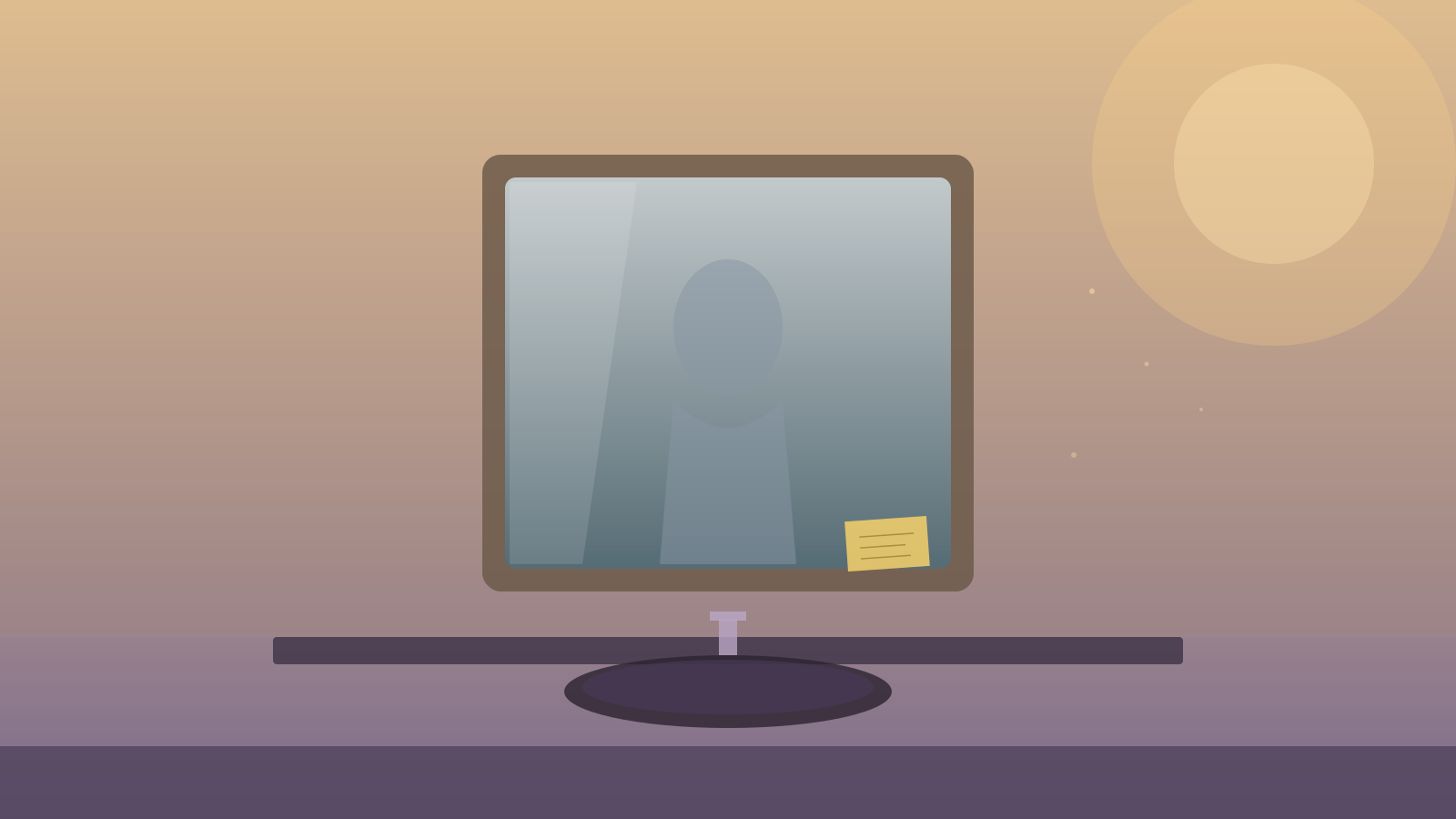
The Mirror Is a Courtroom — Are You Seeing Yourself or a Verdict?
When we look in the mirror, we almost always pass judgment in an instant. "My face looks puffy." "More gray hairs." "I look tired." These evaluations run before we notice them and tint the mood of the day.
Epictetus warned against assenting too quickly to impressions (phantasia). The image in the mirror is one such impression. Physically, it is only reflected light. But we lay a story on top of that light — "older than yesterday," "can't face the day with this face" — and we take the story to be the self.
Stoic training begins with separating the impression from the judgment. Standing in front of the mirror, first "see what is seen." Add no story beyond that. The shadow under the eyes, the curve of the cheek, traces of last night's tiredness. These are facts. They do not need to be ruled good or bad.
The practice is simpler than it is easy. Tomorrow morning, try watching yourself in the mirror for thirty seconds without passing any evaluation. Notice how quickly the words "but" and "still" try to enter your mind. Just observing that speed deepens self-awareness by a level.
The Morning Warm-Up — Marcus Aurelius's Rehearsal
Book 2 of the Meditations opens with one of its most famous lines: "Say to yourself at dawn: today I shall meet with the meddling, the ungrateful, the arrogant, the treacherous, the envious, the antisocial."
It sounds bleak at first, but it is one of the most powerful psychological warm-ups ever devised. Foreseeing difficulty in advance reduces the shock when it arrives. Alongside Seneca's premeditation of adversity, it is a central Stoic technique.
The mirror is a good stage for this rehearsal. While brushing your teeth, run through today's schedule in your head. Pick three moments you are slightly dreading — a tense meeting, a conversation with someone difficult, a bureaucratic errand. For each one, decide in a single word who you want to be there. "Calm." "Kind." "Unhurried."
Making that small decision in advance produces surprising steadiness in the actual moment. People waver at the instant of judgment but tend to stay loyal to a stance they set earlier — behavioral economics calls this a commitment device. The mirror becomes the place you sign that daily commitment.
The Body Speaks First Thing — Reading the Signals in the Glass
The mirror is also where you receive messages from the body. Ancient Stoics did not split body and mind. Marcus Aurelius treated the body as also following the universal reason, and observing its state was part of the philosophical practice.
Redness in the eyes, color of the lips, tone of the skin, asymmetry in the shoulders — these signs are pre-verbal messages from yourself. "I'm tired." "I haven't had enough water." "There's too much tension in my shoulders." Noticing them is raw material for adjusting the day's plan to reality.
Neuroscience suggests that morning self-observation dampens amygdala over-activation and improves prefrontal function. A few minutes of looking at your own body calmly before leaving the bathroom measurably improves the emotional steadiness you bring into the day.
A simple four-point observation works well. First, brightness and redness of the eyes. Second, color and tone of the skin. Third, height of the shoulders and tilt of the neck. Fourth, depth of the breath. If any of them is off, decide early that today is a day to hold back. This alone dramatically reduces the chance of an evening collapse.
"Who Am I Living Today For?" — Three Questions
In On the Shortness of Life, Seneca insisted that life is not short; we waste it. The morning mirror is an ideal place to quietly ask what your day's hours will be spent for.
Try silently asking these three questions while you look at the mirror.
First: "What will I spend my time on today?" Not a specific task list, but the shape of where your energy will go — work, family, your own recovery.
Second: "What will I prioritize today?" Care, speed, accuracy, kindness — you cannot pursue them all at once. Pick one to rule the day.
Third: "Who am I trying to be today?" As a colleague, a parent, a friend, or simply a human being — what posture are you asking of yourself today?
The three questions together take less than a minute, but they are enough to give the day a spine. One reason Marcus Aurelius preserved his character through enormous decision loads as emperor was that he had built the habit of this kind of morning question.
Do Not Be Too Hard on Yourself — A Compassionate Mirror
Stoicism is a philosophy of self-discipline, but it also warns against excessive self-severity. Throughout the Meditations, Marcus Aurelius reminds himself to look at his own faults with the same tolerance he would extend to another person's.
Anyone who tends to criticize themselves at the mirror will benefit from this emphasis. "Failed at the diet again." "I haven't changed at all." "I've gotten old." Pouring this kind of self-indictment on yourself first thing stains the whole day.
Research in psychology consistently shows that people with higher self-compassion reach long-term goals more reliably than people with harsh self-criticism. Kindness toward yourself is not indulgence; it is the ground of sustainable growth.
I had a stretch of life where the first thing I did at the mirror was sigh at my aging face. One morning, somewhere in that stretch, a question surfaced: "If a close friend had this face, what would I say to them?" The answers came easily — "you worked hard yesterday," "don't overdo it today." They were sentences I had never once offered to myself. Starting that day, I began saying a single kind line to myself in the mirror. Within a few months, the face looking back felt different in a way that was hard to explain by any physical change.
Closing the Day at the Mirror — Seneca's Review
If the morning mirror opens the day, the evening mirror can close it. In On Anger, Seneca describes his nightly practice of asking himself: "What bad habit did I cure today? What vice did I resist? In what way am I better?"
While brushing your teeth or washing your face, offer those three questions to the person in the mirror. You do not need complete answers. Asking is itself a letter to the version of you who will wake up tomorrow.
The evening review is not a time for punishment. "I held on a little in that moment." "I wasn't as shaken by that comment as I would have been a month ago." It is a time to notice small progress. The Stoic ideal of the prokoptōn is the person making daily, imperfect forward motion — not the finished sage.
Meeting yourself at the mirror twice a day, morning and night, turns days that used to drift into a story with a hand at the wheel.
Turning the Mirror Into a Ritual — Three Design Hints
Finally, three small designs that help the practice actually stick.
First, place one sentence near the mirror. Write a word or phrase you want the day to carry — "unhurried," "kind," "only what matters" — on a small slip of paper and tape it to the frame. Having it meet your eyes every morning quietly tunes attention. Marcus Aurelius wrote short lines to himself in the Meditations for the same reason.
Second, do not bring the phone into the bathroom. The instant you start reading notifications at the mirror, the self-observation time evaporates. Guarding even three minutes of "just you and the glass" is the minimum unit of this practice.
Third, take one breath before anything else. When you reach the mirror, breathe in, hold, exhale, once. That single breath is the switch from autopilot to a day taken on purpose.
Tomorrow morning, before you reach for the toothbrush, spend five seconds meeting your own eyes. Those five seconds are the doorway through which you enter this one unrepeatable day on purpose. The self-observation the Stoics practiced for two thousand years needs no special equipment and no extra hour. Everything required is already waiting on your bathroom counter.
About the Author
Stoic Insight Editorial TeamWe share Stoic wisdom in a way that is easy to understand and applicable to modern life.
View author profile →Related Articles
Facing the Blank Page — Stoic Wisdom for the Paralysis of Beginning
The Pause Before You Reply — Stoic Wisdom for the Moment Before You Hit Send
The Art of Walking in the Rain — Stoic Wisdom for Embracing What You Cannot Stay Dry From
Trusting the Aging Body — Stoic Wisdom on Making Peace with Physical Decline